
Thirty-Six Hours of Credits: Reconciling the Wallet Line by Line
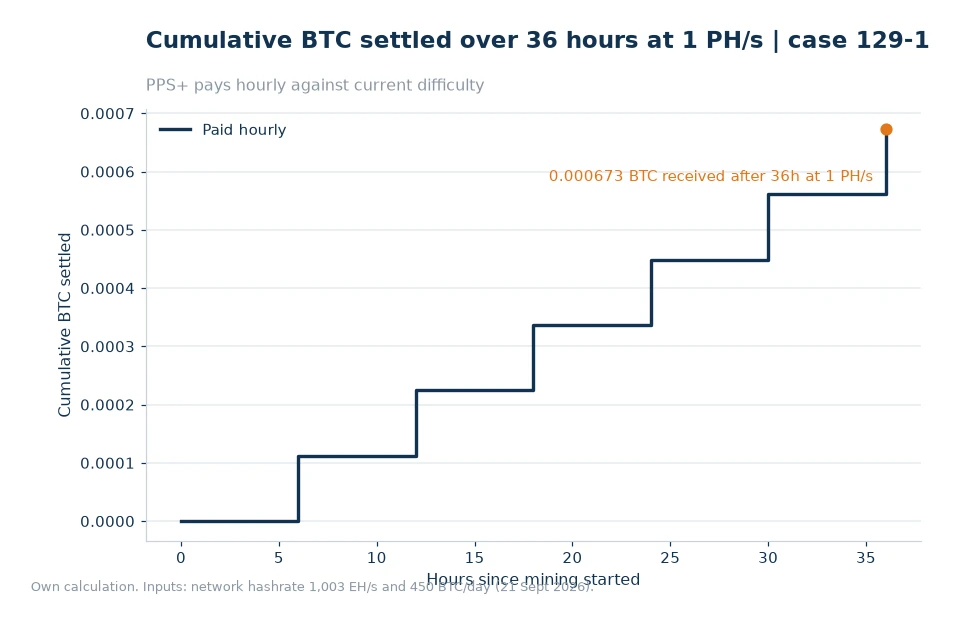
A wallet statement is easy to read as one number and hard to read as a process. Over 36 hours at 1 PH/s the balance grows by 0.00067291 BTC, which is $56.99 at $84,692, but the useful information sits in the steps: 0.00011215 BTC every six hours, or 0.00001869 every hour. Learning to read those steps is what turns a balance into a record you can check.

Key takeaways
- At 1 PH/s the wallet receives 0.00001869 BTC each hour, or 0.00011215 every six hours.
- Thirty-six hours of continuous running adds 0.00067291 BTC, worth $56.99 at $84,692.
- Reconciling means matching each step to a period of uptime, not matching a monthly total to a monthly expectation.
- A gap in the staircase is more informative than a slightly lower final balance.
Why a wallet statement is not a single number
Most financial statements summarize a period, and people read them as a verdict. A mining wallet is different: it is a log of many small settlements, each tied to a specific hour of hashrate. Reading only the closing balance discards the timing information, and timing is exactly what reveals a machine that dropped offline for four hours or a payout that failed to arrive.
The habit worth building is to read the entries rather than the total. Entries have dates and amounts, and a sequence of them forms a shape. When the shape changes, something happened. The total alone cannot tell you whether a shortfall came from one long outage or from a slow drift in hashrate over two weeks.
Reading the hourly step instead of the monthly total
Under PPS+, the block-reward component settles hourly against current difficulty. That produces a credit roughly every hour, each one small, and the size of each depends on the hashrate you contributed during that hour. At 1 PH/s the expected amount is 0.00001869 BTC. Over six hours that becomes 0.00011215, and over a day 0.00044861.
Because the increments are regular, the statement reads as a staircase rather than a curve. A flat stretch is the loudest signal on the page: it means the machine was not hashing, or was hashing well below its normal rate, for a measurable block of time. One flat hour is ordinary. Three in a row is a fault report.
The staircase also has no upward surprises. Steeper stretches do not occur under this scheme, since difficulty is fixed within an adjustment window. If you see a jump larger than the expected step, look for a correction or a delayed credit rather than for a windfall.
Where the credits actually land
The mining account and the wallet are the same account, which sounds like a small convenience and turns out to matter for reconciliation. There is no transfer step between earning and holding, so the statement is a single continuous record rather than two records that have to be matched. The multi-currency wallet holds the balance in the coin you mined, and other coins can sit alongside it if you mine more than one.
The ViaBTC Crypto Wallet is where those credits appear, and the first thing to notice is that the balance and the mining record share an owner rather than a transfer link. Nothing has to be moved to make the credit visible, which removes the most common source of confusion in a two-account setup: a coin that has been earned but not yet swept, sitting in a place the owner forgot to check.
That structure also makes withdrawals simpler to audit. A withdrawal appears as a debit in the same ledger as the credits, so the running balance tells the whole story without a separate exchange history. Keep the transaction ID beside the entry when you move coins out; it is the one piece of information the ledger cannot regenerate later.
What the statement cannot tell you
Two questions are outside the ledger. The first is whether the coins are worth more or less than when they arrived; the wallet records amounts, not purchasing power, and a rising balance can still be a falling dollar value. The second is whether the machine is healthy. A credit proves shares were accepted during that hour, not that the fans are spinning at the right speed or that the power supply is running near its limit.
There is a third thing the statement cannot do: it cannot tell you what the next 36 hours will bring, because difficulty may adjust before they finish. A −2.12% estimate, the figure in circulation on the read date, would raise the hourly credit slightly rather than lower it, but the direction of the next adjustment is not guaranteed either way. Read the statement as a record of the past and let the calculator handle the future.
Keep those questions in separate places. Price belongs to a market view, and machine health belongs to a monitoring tool with its own alerts. Mixing them into a wallet review produces conclusions like a good month being treated as proof that nothing needs servicing, which is how a failed fan becomes a failed board.
Three checkpoints in a thirty-six hour run
Six-hour intervals are a comfortable reading rhythm: long enough that each entry is clearly visible, short enough that an outage cannot hide between two of them, which is the whole point of choosing a spacing by hand.
| Reading | Balance | Worth | Gain since prior reading |
|---|---|---|---|
| 6 hours | 0.00011215 | $9.50 | 0.00011215 |
| 18 hours | 0.00033645 | $28.50 | 0.00022430 |
| 30 hours | 0.00056076 | $47.49 | 0.00022430 |
| 36 hours | 0.00067291 | $56.99 | 0.00011215 |
Worked example
Reconcile the full window from first principles and the statement should agree to the last digit.
- Start at one terahash: 450 ÷ 1,003,000,000 = 4.4865e-7 BTC daily.
- A petahash is a thousand terahashes, so 1,000 × 4.4865e-7 = 0.00044865, carried as 0.00044861.
- Hourly credit: 0.00044861 ÷ 24 = 0.00001869 BTC, which is 1.869e-05.
- Six hours: 6 × 0.00001869 = 0.00011215 BTC.
- Thirty hours: 30 × 0.00001869 = 0.00056076 BTC.
- Thirty-six hours: 36 × 0.00001869 = 0.00067291 BTC, and 0.00067291 × 84,692 = $56.99.
- Four hours of downtime inside the run would remove 4 × 0.00001869 = 0.00007476 BTC, or $6.33.
The last line is the reason to reconcile at all. A four-hour outage is invisible in a monthly total and obvious in a staircase. Catching it the same week lets you check the machine's log while the event is still recent; catching it at month end usually means guessing.
Frequently asked questions
How often should the wallet show a credit at 1 PH/s?
Roughly every hour under PPS+, at about 0.00001869 BTC per credit, which accumulates to 0.00011215 every six hours and 0.00067291 over 36 hours.
What does a missing credit mean?
Usually that hashrate was not submitted for that hour, for example because the machine was offline or reconnecting; check the machine's log for the same window before assuming a settlement error.
Can I keep several coins in the same wallet?
Yes. The multi-currency wallet holds balances for the coins you mine alongside each other, and withdrawals are debited from the same ledger that records the mining credits.
Build the habit on a short window first
Export or screenshot the entries for a 36-hour stretch, write the expected step beside each one, and mark any that differ. Do it once a week for a month and the pattern becomes familiar enough that an anomaly stands out immediately. The ViaBTC App makes the daily check a two-minute habit, and the fee schedule behind the credit, including which listed rate applies to which component, is documented on the pricing page if you want to confirm which listed rate applies to which component before comparing months.
Sources: ViaBTC wallet, app and pricing pages for settlement frequency, the listed 4% on the block-reward component and the multi-currency balance[1]. Chain data, 21 Sep 2026: 1,003 EH/s on the network, a 3.125 BTC subsidy, 144 blocks produced daily, BTC at $84,692. First published 24 October 2026; credits assume the machine never stops.