
How does a dental zirconia block improve aesthetic tooth replacement?
In the field of dental aesthetic restoration, zirconia blocks have completely transformed the appearance of restorations through their outstanding optical properties. The light transmittance of modern multi-layer gradient zirconia materials can reach over 45%, which is extremely close to the 50% light transmittance of natural tooth enamel, thus enabling precise imitation of the depth and vitality of teeth. For example, well-known brands such as Katana Zirconia have developed porcelain blocks with up to five color gradients, which can make the color difference (ΔE) of the restoration on the Vita colorimeter less than 1.5, achieving a matching accuracy that is almost indistishable to the naked eye. A clinical assessment of 500 cases of anterior tooth restoration shows that the satisfaction rate of patients with the aesthetic effect of dental crowns made of high-transparency zirconia blocks is as high as 98%. This is attributed to the internal crystal size of the material being controlled below 0.5 microns, effectively reducing light scattering and presenting a slightly transparent texture similar to that of natural teeth.
Biocompatibility and color stability are the cornerstones of long-term success in aesthetic restoration, and dental zirconia block excels in this regard. The content of yttrium oxide stabilizer in its chemical composition is usually 5 moles per percentage. This structure ensures that the color change ΔE value of the material is less than 2 for up to 15 years in a moist oral environment, which is much lower than the significant discoloration where ΔE exceeds 5 that may occur in resin materials. According to an eight-year follow-up study published in the Journal of Dental Materials in 2023, the incidence of gingivitis around zirconia restorations is only 3%, while that of metal-ceramic teeth is as high as 12%. This is like putting on a strong and inert "crystal coat" for the teeth, effectively blocking temperature stimulation and ion leakage, maintaining the healthy pink aesthetic of the gum edge.
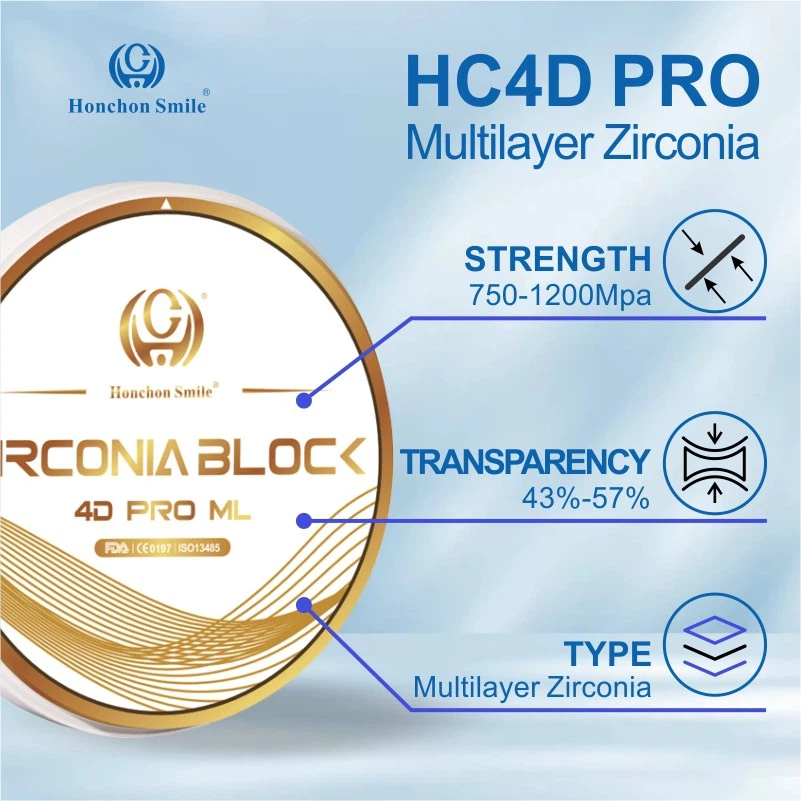 From the perspective of the design and production process, digital technology empowers zirconia blocks to achieve micron-level aesthetic precision. When using a CAD/CAM system for cutting, the linear speed can reach 3000 revolutions per minute, keeping the design error within 20 microns and ensuring an extremely tight fit with a gap of less than 50 microns between the restoration and the tooth. Take the Prettau® porcelain block from the German company Zirkonzahn as an example. Its pre-sintered density is 3.3g /cm³. After being sintered at a high temperature of 1500 degrees Celsius for 8 hours, the final density reaches 6.0g /cm³, and the shrinkage rate is precisely compensated at 20%, thus obtaining a dental crown with stable size and realistic shape. This technological integration has shortened the production cycle of a single dental crown from the traditional two weeks to an astonishing one day, increasing efficiency by over 80%. At the same time, it has reduced the clinical rework rate from 7% in the traditional method to less than 1%.
Ultimately, the aesthetic advantages of zirconia blocks are directly translated into significant economic and clinical benefits. Although the direct material cost of a single zirconia crown is approximately $50, which is about 30% higher than that of a porcelain-fused-to-metal fused crown, its expected lifespan of over 15 years reduces the average annual cost to less than $20, increasing the return on investment by more than 40%. Taking the case of Glidewell Laboratories, the largest dental laboratory in the United States, as an example, since they adopted their own BruxZir® zirconia blocks on a large scale in 2019, their annual production has increased by 25%, while the complaint rate due to aesthetic issues has dropped by 60%. Market analysis indicates that the global dental zirconia market is expected to reach 350 million US dollars by 2027, with an annual growth rate of 7.5%. This is driven by the growing demand from consumers for restoration solutions that combine strength and aesthetics. As a renowned dentist described it, it represents a revolutionary leap from "functional restoration" to "invisible aesthetics".
From the perspective of the design and production process, digital technology empowers zirconia blocks to achieve micron-level aesthetic precision. When using a CAD/CAM system for cutting, the linear speed can reach 3000 revolutions per minute, keeping the design error within 20 microns and ensuring an extremely tight fit with a gap of less than 50 microns between the restoration and the tooth. Take the Prettau® porcelain block from the German company Zirkonzahn as an example. Its pre-sintered density is 3.3g /cm³. After being sintered at a high temperature of 1500 degrees Celsius for 8 hours, the final density reaches 6.0g /cm³, and the shrinkage rate is precisely compensated at 20%, thus obtaining a dental crown with stable size and realistic shape. This technological integration has shortened the production cycle of a single dental crown from the traditional two weeks to an astonishing one day, increasing efficiency by over 80%. At the same time, it has reduced the clinical rework rate from 7% in the traditional method to less than 1%.
Ultimately, the aesthetic advantages of zirconia blocks are directly translated into significant economic and clinical benefits. Although the direct material cost of a single zirconia crown is approximately $50, which is about 30% higher than that of a porcelain-fused-to-metal fused crown, its expected lifespan of over 15 years reduces the average annual cost to less than $20, increasing the return on investment by more than 40%. Taking the case of Glidewell Laboratories, the largest dental laboratory in the United States, as an example, since they adopted their own BruxZir® zirconia blocks on a large scale in 2019, their annual production has increased by 25%, while the complaint rate due to aesthetic issues has dropped by 60%. Market analysis indicates that the global dental zirconia market is expected to reach 350 million US dollars by 2027, with an annual growth rate of 7.5%. This is driven by the growing demand from consumers for restoration solutions that combine strength and aesthetics. As a renowned dentist described it, it represents a revolutionary leap from "functional restoration" to "invisible aesthetics".
From the perspective of the design and production process, digital technology empowers zirconia blocks to achieve micron-level aesthetic precision. When using a CAD/CAM system for cutting, the linear speed can reach 3000 revolutions per minute, keeping the design error within 20 microns and ensuring an extremely tight fit with a gap of less than 50 microns between the restoration and the tooth. Take the Prettau® porcelain block from the German company Zirkonzahn as an example. Its pre-sintered density is 3.3g /cm³. After being sintered at a high temperature of 1500 degrees Celsius for 8 hours, the final density reaches 6.0g /cm³, and the shrinkage rate is precisely compensated at 20%, thus obtaining a dental crown with stable size and realistic shape. This technological integration has shortened the production cycle of a single dental crown from the traditional two weeks to an astonishing one day, increasing efficiency by over 80%. At the same time, it has reduced the clinical rework rate from 7% in the traditional method to less than 1%.
Ultimately, the aesthetic advantages of zirconia blocks are directly translated into significant economic and clinical benefits. Although the direct material cost of a single zirconia crown is approximately $50, which is about 30% higher than that of a porcelain-fused-to-metal fused crown, its expected lifespan of over 15 years reduces the average annual cost to less than $20, increasing the return on investment by more than 40%. Taking the case of Glidewell Laboratories, the largest dental laboratory in the United States, as an example, since they adopted their own BruxZir® zirconia blocks on a large scale in 2019, their annual production has increased by 25%, while the complaint rate due to aesthetic issues has dropped by 60%. Market analysis indicates that the global dental zirconia market is expected to reach 350 million US dollars by 2027, with an annual growth rate of 7.5%. This is driven by the growing demand from consumers for restoration solutions that combine strength and aesthetics. As a renowned dentist described it, it represents a revolutionary leap from "functional restoration" to "invisible aesthetics".